


Personal reflections: ‘To create and dream together’
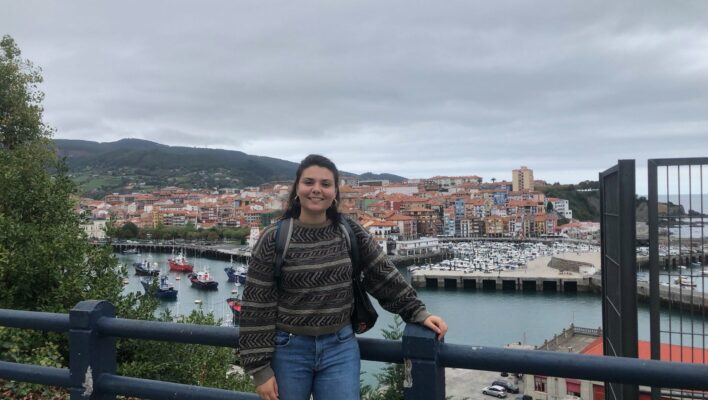
Above: María Cenamor Mochales
By Kate Evans
In October 2025, Lutterworth Press published Joyful Revolution by Diana Skelton, a biography of one of the co-founders of ATD Fourth World, Mary Rabagliati (1942-1992).
Mary died over thirty years ago, so how relevant are her thoughts and writings to today’s society? Through the reflections of María Cenamor Mochales, member of the ATD Fourth World International Volunteer Corps, we can see that Joyful Revolution has a lot to say even now.
Recently, María wrote about several aspects of the book that stood out for her.
Dignity and art
There was the way, early on in the life of ATD Fourth World, that a packaging company was convinced to provide jobs to people in an emergency housing camp in France because employment rather than charity was a way of defending people’s dignity. This led María to think of Zaharna Fabrika, the marginalised neighbourhood named after a sugar factory where ATD Fourth World works in Bulgaria. In Zaharna Fabrika many men scratch out a living by collecting scrap metal that they collect; but recently the place where they can sell scrap metal was about to close. Could ATD Fourth World today work as it once did in France by planning strategies and investing energy to find people interested in establishing business in Zaharna Fabrika to bring dignity to people?
Then there was ATD’s insistence on having beauty to dignify the lives of people in the camp in France. Paintings by Miró, Jean René Bazaine, Georges Braques were brought there. ‘What immediately came to my mind,’ writes María. ‘Is to have one day a читалище – which are cultural places in Bulgaria that work as a community centre, library, etc, and as centre for social life – at Zaharna Fabrika’. The community in Zaharna Fabrika is a working-class district with a large Roma population. Temporary housing has been made the norm, as described in this article about ATD Fourth World’s work there.
María continues imagining: ‘Here we would be able to decorate with art pieces, make it our cultural place to create and dream together, and get educated with the families of the neighbourhood.’
The importance of horizontal living wages
Joyful Revolution explains how ATD’s International Volunteer Corps developed, initially providing only the barest bones of room and board, and later with a horizontal living wage for all, so that ATD Fourth World would not be beholden to funders.
María says: ‘I have worked in other NGOs, and one of the most difficult parts for me was to depend on funds from donors whose political approach I disagree with. For instance, there are institutions that fund NGOs as part of their ‘security’ budget, which I think is a logic that stems from racism and xenophobia. We had to develop our projects knowing that there are so many geopolitical interests which we have to align our proposals to but which are often incompatible with the idea of creating a fairer world. It impressed me that ATD did not have this barrier.’
Violence against women
Another part of the book that caught María’s attention and resonated with her was about how poverty can make girls and women particularly vulnerable to violence and how, often, their suffering was silenced by shame.
One of the passages in Joyful Revolution that caught María’s attention was: ‘When the #MeToo movement emerged, I hoped it might create an opportunity for ATD Fourth World to address the intersection of poverty and violence against women. But still, even as in Mary Rabagliati’s lifetime, we continue to struggle with silence. Violence against women and girls has not been rooted in ATD Fourth World’s thinking, as a principle that guides us. Mary did what she could to support women and to reinforce their support of one another. She participated in global conferences on feminism where she convinced middle-class women to listen to women in poverty. Although she pushed ATD to start new projects for teenage girls, her premature death prevented that. Today, ATD still struggles to speak publicly about violence against women. […] We also still grapple with our worry about compounding stigmatisation about men in poverty. This is gradually changing, but at a glacial pace.’
María reflects: ‘This is something we can improve on, for example, as is happening in the adult groups in ATD´s Bulgarian team. The groups have been created, really taking into account their individuality in a very complex understanding of each person according to their personalities, friendships, family members, gender, ethnicity, etc. Gender is more complex than the dichotomy of women/men, and we have to use it as an aspect to take into account to make sure that all people can be heard, whatever their gender, racial or ethnic background, or their age. (Children’s voices matter too!)”
Called ‘dreamers and lunatics’
‘I think there are so many things to learn from the work of other social movements,’ says María. ‘About very diverse topics, that brings perspectives about what we are doing.
‘For example on the topic of peace building or restorative justice, or the other many tools that exist. Without forgetting the principles of ATD, but getting inspired and seeing the potential that other social movements can also bring to our goal.’
María finds an echo of this in Joyful Revolution, with Mary writing about a worry ‘that the Volunteer Corps agrees too much. […] We need to move ideas forward so we don´t become like certain social workers who have only a small project that will never get people out of the shit of poverty. Instead, [we] should have big political ideas that mobilise society.’
This was the aspiration; however, in the 1970s, at Frimhurst Family House, Mary wrote in a letter to a fellow member of the volunteer corps:
‘We remain somewhat isolated, I think because we make a point of choosing to work with families in the greatest difficulties. Time and again, we are called dreamers and lunatics.’
Perhaps, now that Joyful Revolution has made available the extraordinary life of an extraordinary woman, Mary Rabagliati, it can bring further inspiration and reflection to new generations as it has done for María Cenamor-Mochales, as she finds her way in ATD Fourth World’s team in Bulgaria.
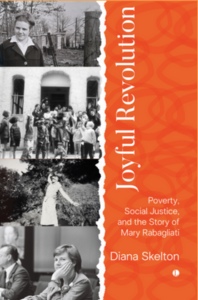 To order a copy of Joyful Revolution, please click here: Joyful Revolution : Poverty, Social Justice, and the Story of Mary Rabagliati.