


Concern and fear about the ‘tangled benefits system’
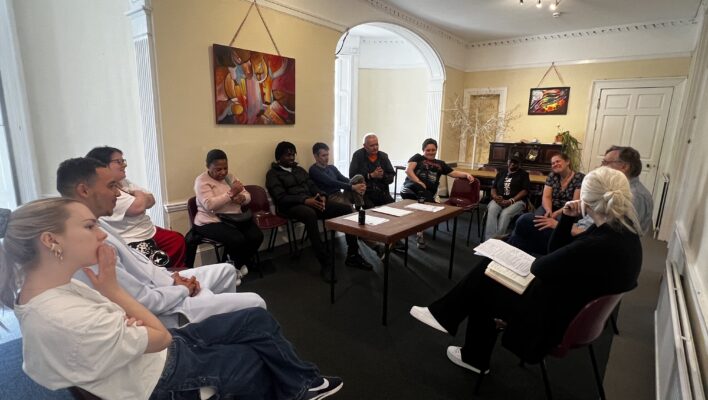
Above: In 2025, people with lived experience of poverty met in ATD Fourth World’s London centre to think together about equity in resource-deprived communities.
10 February 2026 – Yesterday, the UK Government proposed a new series of changes to Universal Credit. They say it is ‘designed to re-balance the benefits system and support more people into work’. Unfortunately, this brings to mind their 2025 proposal to ‘Get Britain Working’, which Associate Prof. James Morrison of the University of Stirling characterised as
‘a moral panic […] channel[ing] timeworn tropes distinguishing between the deserving and undeserving poor’.
Last year, members of ATD Fourth World spent months trying to respond to the Government consultation on these welfare changes. One of the first challenges was that the language of the consultation was confusing and not easily accessible for many of the people being impacted by it.
Deep concern and fear
We took a great deal of time to get our heads together around this language—and some of the questions in the consultation seemed irrelevant to people’s daily lives and ‘unfair of them to ask the public to solve for them’ as one participant said. The content of the policy proposals left every one of us at ATD Fourth World deeply concerned and fearful for the future well-being of the most vulnerable members of our society. Those proposed changes—the stricter eligibility requirements of PIP (the Personal Independence Payment), the freezing of the incapacity benefit “top-up” to Universal Credit (UC) for new claimants, and the reduction of incapacity benefits for under-22s in particular—would cause more people to be driven into poverty and destitution.
Concerns raised in 2025 included in-work poverty for those trying to combine benefits with work. Many zero-hours contracts are so irregular and pay so little that it feels like
‘such a tangled benefits system’.
One participant said: ‘Those who work alongside benefits are going to be massively penalised. Already now, when I am working a lot, I either get a heavily reduced UC or no UC.’ Another was told to repay their benefits before they could earn their wages.
Feeling trapped
Reflecting on experiences that participants or their community had with PIP, people said:
- ‘Trying to negotiate the benefits system is like going round and round in a labyrinth.’
- ‘There’s no way out. There’s no help.’
- ‘They set us up for failure because they want us to attend support sessions but sometimes your appointments with your work coach clash and then they sanction your benefits because you couldn’t take part in two conversations at once.’
- Having multiple assessments at once is quite stressful as ‘I don’t know what they wanted for what’.
- Sometimes the staff carrying out the PIP assessments ‘are not informed enough. I couldn’t even push a trolley without help but the assessor was convinced I could walk a flight of stairs unaided’.
- ‘The fundamental aspect of these conversations with assessors is trust. If they are a complete stranger, can you trust them?’
- ‘They don’t understand enough about special needs or neuro-divergence. You should have staff who specialise in a few different disabilities so you can properly support people.’
- ‘There are incredibly long waiting lists to access PIP.’
- ‘The assessment centres aren’t very accessible. And they are so far away. When you can’t afford the transport, you’re stuck.’
- ‘The government is getting the better of us.’
- ‘You always hear: “we can’t help you” or “we can’t give you the right support”.’
Damaging perceptions
Members of ATD Fourth World also voiced concerns about the language used by the Government about people applying for benefits:
- ‘The picture of benefits claimants they give isn’t true.’
- ‘You shouldn’t judge a book by its cover. Just because mental health issues can’t be seen doesn’t mean they’re not real.’
In the general public, there is a lack of understanding from many people about how disabilities actually manifest. Negative perceptions of people with disabilities ‘have been embedded in people’s heads for years’.
- ‘You are made to think you are just your disability.’
- ‘People have preconceived false ideas that do not reflect reality.’
- One occupational therapist said: ‘At least I’m not wearing my designer clothes so they won’t get ruined by your catheter.’ Many staff are not appropriately trained for these conversations.
‘What am I seen as in society? It’s damaging.’
- ‘People look at the disability before looking at the person.’
- ‘You’re a person. Disabilities are just an aspect, not who you are.’
- ‘You can’t get food and drink in public because you have a catheter. They discriminate against you because of the catheter.’
- ‘When we’re in public, I feel like I have to explain that my son is autistic.’
Jumping through hoops
Participants felt that many people are being punished undeservedly:
- ‘Maybe a small minority claim benefits that aren’t entitled to it so then when we apply it makes it ten times harder for us. We have to jump through all these hoops just to get what we are entitled to, just to get the bare basics.’
- ‘We experience the consequences for mistakes that weren’t our fault.’
- ‘The burden is placed on you.’
The 9 February 2026 proposal
About yesterday’s proposal, James Morrison says that, if implemented, it would include significant cuts to disability or health-related Universal Credit payments for new claimants. He points out:
- “This opens up a huge disparity between new and existing Universal Credit recipients, based purely on the accident of timing of when they became ill and/or reached an age when they could claim this benefit.
- “It—once again—puts ‘cart before horse’, by talking about future investment in additional work-enabling support for sick/disabled people (and specifically, of course, investment with a single-minded work focus). In the meantime, though, this support is not available—and won’t be until near the end of the decade—so in the short to medium term many claimants are going to be pushed into poverty without the support they need to make it easier for them to engage with work.
- “The point about ‘perverse incentives’ once again entirely misses the point—by suggesting that people receiving health/disability-related income-replacement benefits are somehow ‘well off’ (i.e. receiving very generous payments, when we know many of them are really struggling—not least because having disabilities can literally cost more!) The issue is precisely the opposite: i.e. out-of-work benefits paid to unemployed people are (and have been for many years) incredibly mean and poverty-inducing. In other words, the problem is not that health-related benefits are too generous; but that unemployment benefits are woefully inadequate and mean. By 2030, the real-terms level of unemployment-related benefits—according to the IPPR and others—will be half of what their value was in 1971!”
On the positive side, Morrison notes that “the Government has since last year introduced a fairly significant above-inflation uptick to unemployment-related UC (the old jobseeker’s allowance), so that for the first time in many years it will rise fairly significantly (by 6.2% in April – nearly double inflation). However, it still remains risibly low (around £100 a week—or as low as £80 a week for under-25s), so this does little in the long term to address the year-on-year erosion of its value over decades—and, even after this adjustment, unemployment-related benefits remain well below their real value back in the 1970s and even 1980s.”
ATD Fourth World’s conclusion
Among our primary concerns is that these changes will cause many people with non-physical disabilities to fall short of meeting the requirements for PIP, which would lead to them being ‘driven into penury’ [extreme poverty], to quote former Work and Pensions secretary Lord Hutton.
We also believe that limiting access to PIP, which is not a work-related benefit, will get in the way of people ‘getting back to’ or continuing work. In fact, this seemed to be reflected in the government’s own 2025 proposed changes: the “Right to Try” initiative illustrated an understanding from the government that losing benefits can negatively affect an individual’s ability to work; and yet the cuts to benefits continue.
These proposals feel like the wrong way to go about supporting people endeavoring to access work.
We believe that truly supporting people to access work comes with meaningful investment first.
Cuts in short-term costs will likely lead to higher costs—for individuals, for taxpayers, and for the government—in the longer term. These costs are both financial and social in nature.
We believe that the system is broken far further upstream than PIP; but the proposed reforms do not clearly lay out any plans to tackle the issues at the heart of this nation’s difficult times, including worsening poverty and lack of decent work opportunities.
Crucially, these proposals for change are uninformed by lived experience, which is reflected in the apparent lack of understanding of how people actually experience these systems.
We would prefer to see the Government support those who endeavor to access PIP. As it stands, most applications reach tribunal before the allowance is awarded, and the process of appealing and reaching that stage is incredibly difficult and involved.