


Right to Food UK Commission
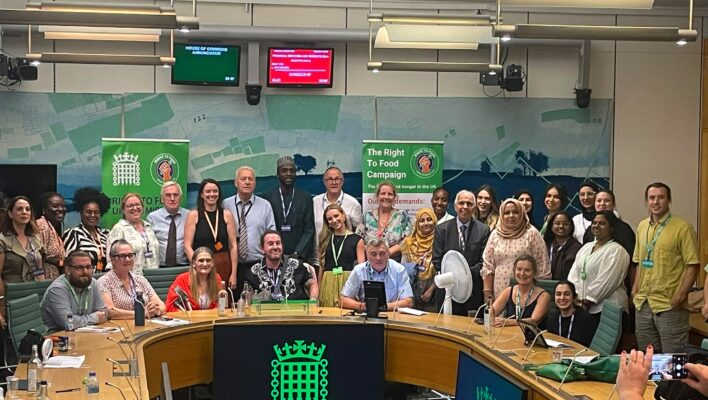
In June 2026, ATD Fourth World submitted evidence to The Right to Food UK Commission, and on 8 July, experts by experience from ATD were invited to speak at this Commission’s presentation to Parliamentarians of interim findings from expert evidence sessions and citizens’ assemblies.
The Right To Food UK Commission was formally launched in Parliament on 17 November 2025 with aims to raise awareness of the unacceptable levels of food insecurity across the UK, to identify solutions and urge the government, policymakers, and public institutions in every UK jurisdiction to take coordinated action to eliminate food insecurity.
The Commission was established by the Right To Food Campaign, led by Ian Byrne MP for Liverpool West Derby, the University of Westminster, the Bakers, Food and Allied Workers Union (BFAWU) and the Food and Work Network. They have been taking evidence from different parts of the UK since January 2026.
The need for a Right to Food Commission
Today food insecurity in the UK represents much more than a lack of food; it raises vital questions about dignity and social value. Despite the United Kingdom holding the fifth largest national economy globally, millions of people have no choice but to rely on food banks. The feeling of being overlooked and undervalued is ever growing. Trussell Trust’s 2025 report ‘Hunger in the UK’ states: “In 2024 14.1 million people were food insecure, 1 in 6 households experienced food insecurity and 6.5 million people turned to charitable food providers.”
The founder of ATD Fourth World, Joseph Wresinski, wrote: “It is not hunger, illiteracy, or even unemployment that is the worst misfortune for human beings. The worst of all misfortunes is knowing you are considered worthless to the extent that even your suffering is ignored.”* http://www.joseph-wresinski.org/en/the-very-poor-living-proof-ofthe
Evidence from ATD Fourth World
In a series of discussions with lived-experience activists held in early 2026, they had something to say on almost every point in the Call for Evidence. The overarching message was that ATD will “advocate for a Right to Food that leaves behind digital surveillance and institutionalised charity, moving instead toward structural equity, corporate accountability, and recognising human dignity.” Some quotations from the submission follow here.
Food insecurity in the UK – challenges
“Joy and personal agency are central. When you struggle to afford daily food, what about birthdays? Holidays? Special occasions?”
Experiences of seeking support for food in the UK (food banks, food pantries, soup kitchens)
“You’re paying £15 to £25 for fruit and veg that are mouldy, bread that is hard as a rock, and tins that are past their sell-by date. For that money, you’d get better quality in a shop.”
Experiences of free school meals
“They do free school meals in primary school, but when your kid goes to secondary school, even if you’re still on Universal Credit, you have to pay—and that’s just for the basic meal. The ones who can pay more get a better meal. And once because some kids were acting up, the teacher denied them food!”
Experiences of community kitchens
“When you want to go to a food bank, it’s hard. There aren’t any at all near where I live. The one nearest to me is quite far and I don’t know the bus routes. So I’d need a lot of time to get there and back and I have to have the bus fare. There’s a community fridge I could go to, but I have serious allergies and I worry that there’s cross-contamination there because I don’t know how they store the food.”
Experiences of the impact of social protection safety nets, such as income support
“We shouldn’t need food banks but benefits are not enough.”
Evidence on the importance of a living wage for all on the ability to feed individuals and families
“The minimum wage for 18-25 year olds is a problem. They get paid less than the over 25s but have to pay the same costs for food. The cost of food is phenomenal.”
How access to food impacts the right to family life
One of the questions asked by the Commission in its Call for Evidence was about the impact of policies that affect families’ abilities to feed themselves. Members of ATD Fourth World speaking from lived experience particularly highlighted policies related to children’s social care.
For example, if a parent has recourse to a food bank, this has sometimes been interpreted as evidence of “bad budgeting” and construed as a form of neglectful parenting, increasing the family’s risk of a social service intervention. The negative professional judgements about parents who don’t have enough food in the house can also have a knock-on effect on people’s sense of their own parenting capacity.
Some parents say:
- “Social services are always looking inside your cupboards and fridges and freezer to judge if you can keep your kids by seeing how much food you have. As a parent, you start second guessing yourself until you don’t know if you’re coming or going.”
“Some parents who would be allowed by social workers to bring their kids home from care take one look at the cost of living and rising food prices and they think, ‘How can I afford to bring them home now?’”
‘It’s judged as neglect’
- “Social services keep track of how many times you go to the food pantry and if they think it’s too much, they come and take your kids.”
- “If you have 4 kids and only 3 packets of crisps, they’ll write down ‘neglect’ because they think one of your kids won’t get any crisps. Or if you’re giving the kids cereal at dinner time, that’s judged as neglect too. It’s judged that you’re not doing a good enough job. When I was a kid, social workers said I was getting starved by my parents but it wasn’t true.”
- “After your kid has been in foster care, the problem is that the foster families buy expensive brands with jacked up prices. My nephew now only wants branded foods like Cocoa Puffs that cost £3 or £4, when the cheap version is only £1 or £2. He’ll point at the cheap one and say, ‘I don’t want it, that’s not what I got in foster care’, and so his mother feels like she’s failing him.”
Find ATD Fourth World’s full submission to the Commission here.








Above: Photos from the 8 July event in Parliament convened by MP Ian Byrne. Speakers included Commission member Jen Clark and three experts by experience from ATD: Tammy Mayes, Thomas Mayes, and Maryann Broxton.
Speaking in Parliament: ‘Poverty isn’t a choice’
For an event on 8 July, Commission member Jen Clark invited three experts by experience from ATD Fourth World to be featured speakers.
Maryann Broxton spoke about hunger being an income problem, not a food problem: “There is hunger because of low wages, insecure work, and rising housing costs”. She highlighted the importance of being able to associate food with joyous celebrations and also pointed out that negative childhood experiences with hunger can lead both to lifelong health problems, and also to a form of PTSD with certain foods triggering bad memories. In a memorable turn of phrase, she pointed out:
“We often say ‘the rent eats first’ because you’re always making the hard choices between feeding your kids or covering rent.”
Tammy and Thomas Mayes focused on the right to food for people living with ill health or disability:
“If you or your kids have allergies and food intolerances and you live in poverty, food that meets your needs is not affordable. For example, if your children have different allergies and the food bank doesn’t offer enough choice, then you’ve got to decide which one of your children you can feed this week.
“You don’t get the choice. If you’ve got people in your family that are allergic to food or can’t eat that food for whatever reason, you lose out because if you’ve got no money, you can’t go out and buy the other food, and it’s very hard to choose. Which child do we feed? Which child do we not feed? Have we got to sit there and watch our child cry because we’re trying to make them eat something that they don’t even like?
“Poverty isn’t a choice. Poverty is down to the government. At the moment the disabled on benefits are being penalized yet again. We’re the unpaid carers. We get £82 a week to do a job that’s over 37 hours a week. It’s always the SEND families and the disabled families and the people on benefits that are actually getting the brunt of poverty. Yet people that are on benefits, most of them work, and the rest are disabled. It’s not a choice to live in poverty. Hunger is a political choice.”
What does the Right to Food mean?
The Right to Food is an internationally recognised human right. The definition aligns with the core elements of the Right To Food articulated in General Comment No. 12 of the United Nations Committee on Economic, Social and Cultural Rights: “States parties recognize ‘the right of everyone to an adequate standard of living for himself and his family, including adequate food, clothing and housing, and to the continuous improvement of living conditions’, while […] more immediate and urgent steps may be needed to ensure ‘the fundamental right to freedom from hunger and malnutrition’. The human right to adequate food is of crucial importance for the enjoyment of all rights.”
This right goes well beyond the urgency of preventing hunger, or supplying people with emergency food. Adequate food includes issues of availability, affordability, nutritional adequacy, if it is received in a dignified manner, and whether it is culturally appropriate.
How is the Commission working?
The Right to Food Commission has been examining the extent and causes of food insecurity across the UK, including the impact on public health and the role of labour market conditions, social security, and asylum and immigration policies as operators of food insecurity. Its final report will consider how government policy frameworks can tackle food insecurity, support and invest in community-based food initiatives, and explore the legislative changes needed to establish an impactful statutory Right to Food.
The Commission’s Call for Evidence asked experts, frontline organisations, and individuals for first-hand accounts of food insecurity. This evidence is being utilised to shape a legally binding Right to Food. To make this happen a community led road map for legislation shall be created by Autumn 2026. The ultimate goal is to eradicate hunger in the UK by 2035.
Why does this evidence matter?
One of the Commission’s questions was: “What type of accountability mechanism would ensure the voices of those most impacted are collected and acted upon?” This is a vital step because for any policy to be brought to life, it is helpful to have people with lived experience bring their unique vantage points to ensure effective implementation and evaluation.
In the evidence submitted by ATD Fourth World, we proposed a very specific tool. ATD Fourth World, working together with the UN Special Rapporteur on extreme poverty and human rights, has developed a process for the Inclusive and Deliberative Elaboration and Evaluation of Policies (IDEEP).
IDEEP rewires how decisions are made by using a model of active, free, informed and meaningful participation aligned with human rights expectations in order to ensure better outcomes with better legitimacy.
Listening and evaluating stories from people’s lived experience is essential to creating solutions. These voices illustrate more than a statistic on paper, they bear witness to the harsh realities people face day to day, the unnecessary struggle of what it is to go without, and they prove why top-down food policies are failing the nation.
What could a Right to Food change?
ATD Fourth World hopes that with public bodies having legal duties in place there will be government accountability that will ensure that people have access to the adequate food that can ensure good health and enjoyment.
Prevention is better than cure; implementing a legal right to food would move society away from emergency food aid and towards a model founded on dignity and human rights.
With this right enshrined in law, the general public will have improved health, with diet-related illnesses lessened through better access to nutritious food.
This right would also underpin a stronger moral code for society, based on respect, kindness, and valuing each person for the greater good of people and the country, ensuring dignity for all.
___
*Joseph Wresinski, “The Very Poor, Living Proof of the Indivisibility of Human Rights” (1988 text prepared for the French Commission on Human Rights).